News
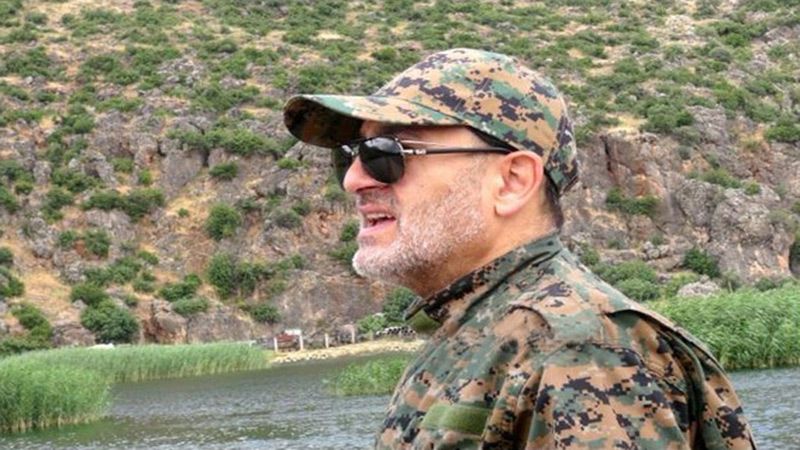
Mostafa Badreddine: What You Planted in Syria is Being Harvested
Elie Hanna
Two cars crossed the Lebanese border into Syria. The neighborhoods of Damascus are burning and the ball of fire in the two Ghutas is rolling towards the walls of Sayeda Zeinab’s shrine. In one of the two vehicles, Sayyed Mustafa Badreddine - the military commander of Hezbollah’s forces in Syria - received his new mission.
It’s about an hour’s drive from the Masnaa point to the "Al-Sitt" area [Sayeda Zeinab]. This is all that was separating Zulfiqar from what he loved since his adolescence - the bullets and shells pouring from every direction. Bullets from the town of Shabaa penetrated his car on the Damascus airport road. It was not the time for martyrdom yet. The commander still had major tasks.
The situation became more serious. He participated in opening up dozens of operation rooms on several fronts in order to stop the expansion of the militants and prevent them from completing any field achievements. Since the early days, he met with the commander of the Quds Force in the Iranian Revolutionary Guards, Haj Qassim Suleimani, to initiate coordination and joint action in a strong relationship that formed the allied forces and remained in place until his martyrdom.
"Sayyed arrived and gave a strong impetus to the men defending the Haram," says one of the leaders who accompanied him on the ‘first trip’. The enhanced Radwan forces [the elite forces of Hezbollah] quickly arrived. The journey of cleansing the surrounding area of Sayeda Zeinab began followed by the liberation of the town of Akraba, which "took great effort because it connected the airport road area with the Sayeda Zeinab square," according to the leader.
He was one of the "jihadi aides" of Hezbollah’s Secretary General His Eminence Sayyed Hassan Nasrallah and a keen observer of his military/security work. He spent his time between the operating rooms and the lines of engagement along the Syrian border. ‘Sayed’ toured from one point to another. Many faces met him at that point. The "secret face" went out into the battlefield. "He had a special way of greeting the young men," says one of the fighters. He rarely shook hands, “embracing was more his habit, especially for those returning from their duties.” The fanatic for details even preferred to "intervene" in tactical matters. One of the Mujahedeen tells a story about "a very annoying sniper in Hujjaira [a town in western Ghouta]."
The commander asks, "Why, the brother, why isn’t it working?” He went down to the tank and walked beside it to set its target at the sniper. “Toss it to me,” he said.
Away from the "moment of engagement", Zulfiqar was interested in the details of the young men’s lives. He inquires about their studies, and asks the question "What about your university?" a lot. He also asked about their family and religious lives. His well-known hardness turns soft towards the members. "My love, my heart" are words he uses frequently. One of the young men he met during an operation describes him as "the King of Morality". The tremendous moral boost that he spreads among the attendees does not deter him from pursuing "the fighter and the prestige". He loves the "tidy uniform" and tends to the disciplinary style, especially with details such as military salutations and organizational rigor. "Just as he punishes for mistakes, he also rewards."
Confronting Bandar
The commander and his men completed the first phase of the mission by liberating the villages surrounding the town of Sayeda Zeinab. Then he headed towards securing the airport road and to the most important battle near him: ‘the gate of eastern Ghouta’, the town of Otaiba.
That day, he was informed by a specific source in the party – according to the leader accompanying him – that "the Saudi prince and the head of the General Intelligence, Bandar bin Sultan [who took over the Syrian dossier in July 2012], is closely following the battle, which is part of a plan run by Riyadh and its agents," [December 2013]. Their gunmen succeeded in achieving the largest breach and penetration from Otaiba deep into Ghouta, threatening Damascus.
He reminded the fighters during the battles of Qalamoun that "the blood of our children and women are still on the walls in the Dahye".
During the attack, he entered the operation room and saw the frustrated faces; he said “what’s wrong? Get up! Our will is strong. The way they entered, we will expel them. As long as we are here, they do not exist. They cannot stay.” A leader who experienced that period recounts: "The Battle of Otaiba was one of the most important battles that shook the mind of Sayed and his sense of security.”
The leader tells Al Akhbar, the battles of eastern Al-Ghouta was the same “until he was able, along with a number of his main leaders, such as martyr Hajj Alaa Al Bosna and martyr Shabib al-Hajj [Abu Tarab], along with the Syrian army, to lead the liberation of all the villages of Ghouta along the airport road.”
He was practical to the utmost extent. During the Otaiba operation, he was following-up from the line of contact, and at a distance was a “military aid team” treating a number of wounded. A young man came up to him and told him, "Move aside, let us know how to do our job.” He replied, “Go ahead, take your time.” His colleagues were shocked and one wondered, “Why did you speak to him like that? Do you know who the brother is?” He replied, “God no, I did not know him.” Sayed intervened: “no one talks to him. He was doing his job and he behaved spontaneously. That is what I like.”
During the Qusair operation [May-June 2013], the martyr followed-up on the battle with the assigned leaders from a distance. The accompanying leader recounts; “he was busy ending the armed presence in western Ghouta and expanding the security zone in the Sayeda Zeinab area as well as repelling the massive attacks on eastern Ghouta to cut off the main supply line from Badia to Ghouta and Damascus. Thus, he resorted to ambushes and the explosive devices to drain the militants.” Perhaps the most prominent of these is the famous Otaiba ambush [October 2014], which "the Israeli pondered on as well."
The blood of our children is in Qalamoun
In the Battle of Qalamoun [Winter of 2014], he and a group of resistance officers headed toward a hill overlooking the area. He began planning using maps he brought with him. The two leaders, Ibrahim al-Hajj [Hajj Salman, who was martyred in Iraq in July 2014] and Hatem Hamade [Hajj Alaa, martyred in Aleppo in October 2016] were charged with field monitoring. The operations were launched with the participation of other key leaders with the Radwan forces to liberate most of the important towns until Yabroud, where IED factories were discovered. Dozens of equipped vehicles set to cross into Lebanon through the eastern chain’s dirt roads were also dismantled.
Zulfiqar was among the few leaders who integrated security work with military work
“Yabroud was a militant stronghold. Saudi Arabia and Qatar were interested in the battle of separation in Qalamoun.” The aim of these operations after Qusair is to "clear those areas of strategic importance, to protect Lebanon from any attack on border villages as well as protect Lebanon from car bombs that showed that some of the previous bombings in Lebanon came from these areas." During that period, he was present daily and traveled long distances along military points, motivating the resistance fighters and reminding them that “the blood of our children and women are still on the walls of Dahye.”
A two-minded man
Badr al-Din was among the few leaders who integrated military work with security work with over decades of experience. This school enabled the martyr to face the great dangers that hit Syria with a different vision. On the military side, one of his team members says that "Sayyed took the first step to halt the dangerous decline in the course of the battle as he stopped the militants’ advance. Then he began to expand the safe cordon of the capital and the shrine. On a parallel track, his "security mind" continued protecting Damascus from the Takfir networks. The light on the capital and its Ghouta was extended by Zulfiqar in parallel with different areas, most notably through the battles in the Homs neighborhoods, where he went every week to manage the front and participate in the planning with Syrian army officers.”
An effective reason for the steadfastness of the trapped residents of Kafraya and Foua in the countryside of Idlib is the equation established against Zabadani and its surrounding neighborhoods. Zulfiqar was present during all the battles of the city with the leaders of the ‘Radwan’ forces until the ‘Ahrar Al-Sham’ and ‘Nusra front’ fighters were besieged. The equation continued after his death and was a great success. With it, the presence of armed fighters in the western Damascus countryside was ended and the people of the two towns were saved from the specter of massacres. In addition to this task, "Sayed classified the Zabdani battle as an important strategy to protect the borders and the international road [Beirut-Damascus], which the militants have approached and targeted. The operation was dubbed Zabadani. It was for the entire surrounding areas and its overlooking hills.”
He spent 5 years spent in daily work between planning and moving from one front to another.
His car was hit by bullets on the Damascus airport road. "He used to return to the southern suburb [Dhaye] for no more than 24 to 48 hours, where the Syrian situation is being monitored in terms of protecting the Lebanese interior as well as dismantling terrorist networks and protecting the border," someone close to him said. He saw the general situation with a strategic outlook, repeating "Do not be afraid of their control over the vast landscape. Now, the most important are the vital places such as airports, water and electricity; and more importantly, the preservation of cities and leaving the empty spaces.”
The points where the resistance worked and Badr al-Din was not there were rare. During the battles of Aleppo, he was “part of it in the joint operations room and a supporter for some of the main operations in the southern countryside, where he had several rounds there, the most important is when he supervised the recovery of the Athriya-Khanaser road from Daesh [February 2016], the day Hajj Alaa Al Bosna was martyred. He was affected a lot by that. He loved him and considered him the best of men in the difficult missions,” says one of the men who worked with him. Also, his participation in the battles of Sahel Al Ghab extended over a long period of time. In one of the meetings he called for in the "Sahel", after ending the presentation on the military situation and the nature of the region and the threat, he addressed the audience: "We have hope in you, and your steadfastness is the foundation. I am on your side and your supporter, and I will not leave you and I am following-up with you minute by minute. You are the protectors of the yellow flag.”
The man with the charming presence was never absent from the battles along the coast, the day that the city of Kassab on the Turkish border was retrieved -in the battles against Daesh, east of Homs, in Qaryatain and Tadmor [Palmyra]. Both of Zulfiqar’s ‘minds’ allowed him to look at the full Syrian map from ‘top to bottom’ with its regional and international complexities. He went where the course of the battle was grave and fraught with danger. He raced with the decision-makers and the countries supporting the insurgents, working with his brothers to discover any advance planning of the opponent or move, so that he can head with a specialized team towards the target area and “not return until he breaks the equation or stops the progress of the militants.”
He entered and Syria was on the edge of the abyss. He along with a team of leaders, cadres and resistance fighters did not rest for years, recording great achievements and building blocks of successes that were reaped after his martyrdom. This is my biography, read it. For I have returned as a martyr carrying the banner of victory.
Source: Al-Akhbar, Translated and Edited by website team